
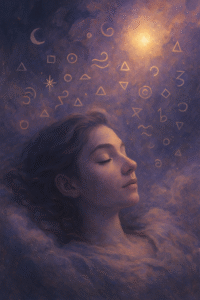
Dreams are the oldest language in the world — a nightly theatre where symbols, emotions, and hidden truths weave themselves into stories of meaning. Every human being dreams, yet few are taught how to listen. Dreamwork is the art and science of remembering, recording, and reflecting upon those messages — an ancient practice that now finds new life through modern technology and psychology alike.
In this introduction, we’ll explore what dreamwork really is, how it differs from simple dream interpretation, and why it remains one of the most powerful forms of self-discovery.
🌙 The Universal Language of Dreams
Long before laboratories measured REM cycles, civilizations understood that the sleeping mind speaks in symbols. Egyptian priests, Greek philosophers, and Indigenous shamans all used dreams to guide healing and prophecy.
Modern psychology re-entered that conversation through Sigmund Freud, who called dreams “the royal road to the unconscious,” and Carl Jung, who expanded the idea into a map of archetypes — shared images and patterns that appear across humanity.
Dreams are not random; they are deeply personal mythologies that reveal the inner condition of the soul. Jung wrote that “dreams are the guiding words of the soul,” and that by studying them, we come to know the parts of ourselves that remain unspoken in waking life.
🪞 Dreamwork vs. Dream Interpretation
Traditional dream interpretation often stops at symbol dictionaries — snakes mean transformation, water means emotion. While these can be starting points, dreamwork goes deeper.
Dreamwork treats every dream as a living dialogue with the unconscious. Instead of asking “What does this mean?” we ask, “What is this saying to me, right now?”
A dream of falling might not “mean” failure — it might invite you to examine where you’re letting go of control. A dream of an old house might reflect layers of your own psyche waiting to be explored. The key is relationship, not translation.
🔥 The Psychology and Science of Dreamwork
Science has confirmed that dreamwork isn’t mystical wish-thinking — it’s measurable brain integration. During REM sleep, the emotional centers of the brain light up while the prefrontal cortex, responsible for logic, quiets down. This allows the psyche to process emotion symbolically, through images instead of words.
“Until you make the unconscious conscious, it will direct your life and you will call it fate.”
— Carl Jung
Engaging with dreams after waking strengthens neural pathways of self-awareness. Journaling about dreams has been linked to lower stress, improved creativity, and emotional regulation. In other words, when you honor your dreams, you train the mind to notice and integrate what it would otherwise repress.
🌕 Beginning Your Dreamwork Practice
You don’t need to be a psychologist to begin. All you need is curiosity, consistency, and compassion for whatever appears.
A simple nightly ritual:
- Set an intention before sleep — a sentence such as “Tonight I will remember my dreams.”
- Keep a journal beside your bed. Write down every detail upon waking — even fragments or feelings.
- Reflect, don’t analyze. Ask what emotions stand out and what part of your life they echo.
Over time, you’ll begin to notice patterns — recurring settings, emotions, even colors. These form the vocabulary of your personal myth.
✨ Closing Reflection
Dreamwork is not about decoding secret messages; it’s about remembering who you are beneath the noise of waking life. In the landscape of dreams, the soul speaks freely — in symbols, in stories, in the language of light and shadow.
When you write down a dream, you take the first step in transforming fate into awareness.
Begin that dialogue with yourself. Dreamfire is here to hold the mirror.